Choose our thoughts

CHOOSE our thoughts. Decide what we think about. Proactively select them, for our experience of life reflects what we think about.

Yet, how often do we choose? Or even know that we can?

So often we lose ourselves in our thoughts. Immersed so deeply we didn’t even realized that they are thoughts – They’re not us.

We’re not even having thoughts at that point; the thoughts are having us.

Be aware of our thoughts. Don’t fight them. Don’t fear them. Or judge them. Just see them, watch them, and stay aware of them.

Eventually, maybe we can even choose them. Think about the thoughts we want to fill our mind with for a life of meaning and growth. Choose what we think about: our  loved ones, what we’re put on this Earth to do, and anything that can help us grow.

Choose the light.

Let go of thoughts that don’t serve us. Let them go not just to forgive someone or some past, but also for our own sake:

Let go of resentful thoughts and narratives for our own sake.

Here, letting go is an act of kindness to ourselves. We deserve that and we can give it to ourselves.

We can love ourselves by letting go of resentment toward someone else.

The better we learn at choosing, and the better thoughts we choose, the better our life experiences become.

We can love ourselves.

“Letting go” … of what? Freeing ourselves from the part of us that can feel hurt

Emotional triggers can be our friend.

They show us where we feel hurt and what we need to work on.

What hurts or triggers you?  Answer this question, but don’t stop. Also ask yourself, what is within you that can feel hurt?  Just thinking about this question may start helping you gain more peace, as it has for me.

The clinging mind

Feeling ignored and, even worse, disrespected, is a trigger for me.

Often, the mental chatter makes it worse.  After an unpleasant conversation has long ended, the mind just can’t let it go. “How dared they talk to me like THAT??” “After all that I’ve done for them?”

The mind is very talkative, have you noticed?  The mind clings the replays. And once it gets going, the heart keeps feeling worse. Then you start thinking very unkind thoughts. Have you experienced this?

Who or what feels hurt?

What is the “I” that can feel “mistreated”? Why do “I” need to be treated a certain way?

Any particular “way” that I should be treated ultimately is an idea. Actually, a bunch of different thoughts that I’ve accumulated over a lifetime.

When I feel looked down upon, that may just be my ego feeling smaller than the other person. Why does my ego resist being small? Why does it need to feel big?

Likewise, the “I” that needs to be treated a certain way is a mental construct, a bundle of thoughts.

When we give up the need to protect that thought form, like the ideas of “how I should be treated or talked to”, and release (let go) the part of us that can still feel upset about some event or someone after so many years — when we let “it” go, we cease to be “hurt”.

“Letting go” can be so hard to do

Let’s say you lost a good friendship to a big argument years ago. You and your friend shouted at each other, called each other names. It bothers you every time you think about it.

You try to “let go” by not thinking about it.  You try to forget. You suppress.

But the memory and feelings about the event keep bubbling up.  They could lay dormant for years, even decades, but they reemerge sooner or later. They return as they must, no matter how hard we suppress, because of the countless situations and people that can suddenly remind us of them.

And every time they return, we feel bad again. For example, as soon as you remember your fight and loss of friendship, you might feel sad and angry instantly, and you might even ruminate on the event for days. You still feel hurt.

Who or what to let go of

We can’t let go THIS way because, maybe, we’ve focused on the wrong thing.

We tend to focus on the memories of people and events that we feel bad about, the object of our negative emotions.

What if, instead of trying to let go the memory of the event, we focus inward on the experiencer of the event, to understand what is WITHIN US that can still feel hurt, angry, after all these years?

When we feel intense negative emotions from memories of events, or people, or whatever else, we can try to watch, observe, and understand our own logic (possibly unobserved previously, and subconscious) leading to those feelings. And then let that part of US go.

What’s been helping me more

Memories of a few events from years ago can still bother me a lot. Even though I know they don’t matter in the grand scheme of things, I still get so offended and angry every time they come up.

Lately, I started asking my myself:

What is it about ME that gets triggered by these events, which involve the feelings of being ignored, bullied, and betrayed?

The part that is in ME that gets triggered, is the part that I want to let go.  The part that gets upset when feeling that way.

Letting that part of us go can release us from suffering.

Remembering who we are

Letting go the part that gets triggered doesn’t mean losing who we are. In fact, letting go might further reveal who we are.

Many spiritual traditions say that our true self is pure awareness. Invisible and eternal.

Am I truly awareness, a bundle of thoughts, or both? Are you? I don’t know, and I’m not sure that the answer truly matters.

But I would like to identify more with the awareness than the bundle of thoughts.

Mercy and forgiveness

It also helps to remember to be more merciful. Be merciful to those who have “wronged” us. They didn’t know any better.  They might not even have meant to. They didn’t know. 

In any event, the “me” who they wronged is a bundle of thoughts. I can choose to let go the need to protect it.

Our friends

So, let go the part of us that can feel emotionally triggered about the past, not just the memories that trigger us.

That’s why emotional triggers, as unpleasant as they may feel, show us the path to inner peace. They are our friends.
Manifesting…. YOU

What would you like to manifest?

For what reasons would you like to manifest, it?

Many of us would manifest money, respect, love, children, and power. “Life would be better if only I had _____,” so our mind says. Sure, I would love them too!

Nothing’s wrong with external phenomenon. “Other” people and things. Anything that’s not “me”. They can make us feel good, very good in fact, and sometimes even elated.

But will they truly make us happy? For how long can we put off the search, the yearning, for something or someone “better”?

How about if we just bypass these intermediaries, money, love, and reputation, things that we think will bring happiness, and go straight to the source and directly manifest happiness?

You see, instead of chasing after the people and things that we think will bring happiness, and finding out later that we’re still wanting. Why not just figure out what happiness means to us, what it requires from us, and work from there?

So first, figure out what happiness looks like and means. To you.

Wisely choose how we define it. The lower the threshold the happier we become. The higher the bar the worse we feel.

A wine novice enjoying their box wine feels happier than a wine afficionado complaining about their vintage Bordeaux.

To the novice, any box wine, and perhaps no wine at all, can help induce laughter and other merriment. To the expert, no wine can ever be good enough, if “good enough” requires meeting some unobtainable criteria for perfection.

What we define to be “good enough” determines how good we feel. It’s not just our job, mortgage, or relationships, that determine our life quality. The way we think has so much to do with it, so much more perhaps.

We are responsible for and the generator of our thoughts. That means WE have the power to lower the threshold for achieving happiness, and therefore the power to make ourselves happier.

If we want to be happier more often, and who doesn’t? Then let’s lower the condition for happiness. Be happy when it’s sunny, and be happy when it’s rainy. Be happy when we get a raise, and be happy when we don’t.

Don’t let external circumstances determine when and if we get to feel happy.

Allow ourselves to feel happy.

Let our happiness depend on nothing and no one.

For me, happiness can just be a deep sense of wellbeing. When it’s quiet inside. It doesn’t need to require reliving my first love, college graduation, or any other memorable life events. Or gaining a better home, career, reputation, and love in an imagined future. Actually, when it’s quiet inside, I can enjoy anything. And when I can enjoy anything, I feel happy. Don’t you feel the same way?

If happiness depends on nothing and no one, then what is left?

YOU

So, YOU, and maybe ONLY you, have the power to provide true happiness to yourself.

And who is the “you” to be manifested? That is a question worth considering. In fact, we must answer that for ourselves. Figuring out and answering that question may be one of the reasons for being here in the first place.

Who are the inner children

Healer and author Terrence Real wrote about our inner “wounded child”, “adaptive child”, and “natural child”. Who are they?

The wounded child and adaptive child for me are repetitive thought patterns and automatic reactions that stem from unreleased energy created by traumatic experiences.

Frozen thoughts born from memories that no one asked for or wanted.

They repeat because they’re frozen.

To free ourselves, they need to be thawed.

To heal, one must pay attention to the wounded and adaptive children – these frozen and stuck thought patterns. To see them, and to understand how they think when situations, i.e., “triggers” arise.

They generate reactivities in our lives. I see it now. I overreact to something, even today, when my inner children — deep memories and thought patterns — are activated. They are scared and they protect themselves, they might even fight back when they feel endangered.

Remember they are thoughts of a small child experiencing trauma.

They don’t have the life experience of an adult, to think logically. They only know what a small child knew up to that point. That’s why their fears are disproportionate to reality today, why they are often more sensitive and reactive.

They are deeply ingrained thought patterns born from traumatic events. From memory.

If we don’t watch them closely, they can and will take over in unhelpful ways even if they are trying to help.

Unwatched, they still run our emotions and act out in ways that no longer serve us. And often hurt us and others. But it’s not their fault. Don’t blame them. Don’t judge them.

Grievances, thoughts of them. Like “how dare they treat me this way”? These are disturbances generated from recurring thought patterns stemming from unreleased energies of the past.

And we have to watch them not just when triggers arise, but in general. They may be making fundamental choices in our lives.

We must connect with these different parts (memories) of ourselves, get to know them, accept them, love and protect them. Stop criticising, feeling ashamed, and ignoring them. And learn that we are the first responsible person for our own inner children and ultimate happiness.

The Most Important Connection

Connection is the most important and fundamental need. The deepest desire. We want to love and be loved. To hold and be held. We seek connection with family, friends, with romantic partners. Without the right connection, something important seems missing. We feel incomplete.

Many of us seek this connection our entire lives. Never satisfied. Never complete. I fear this fate from time to time, if I’m totally honest with you.

Some of us may feel this way even if we’re loved and surrounded by love from family and friends.

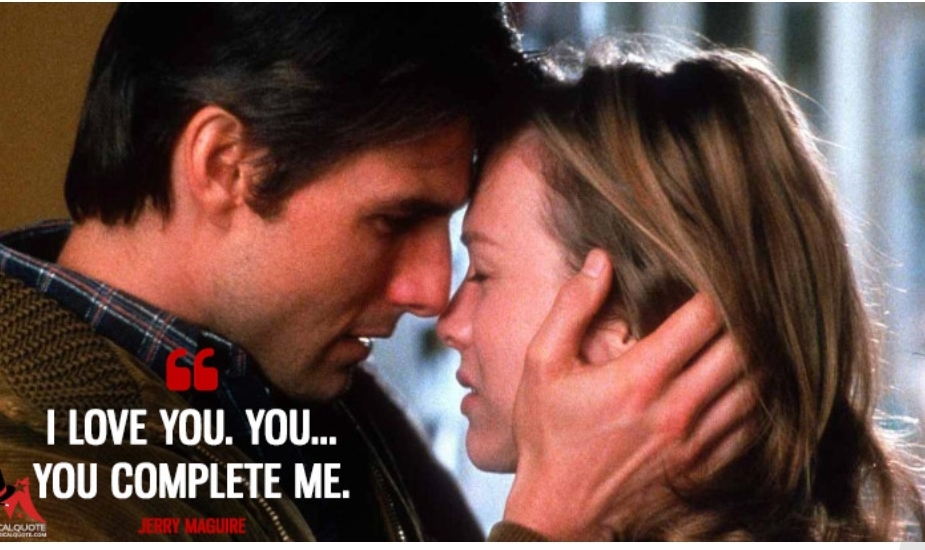
Was Jerry Maguire right?

Until we connect with ourselves, can anyone or anything make us whole? And complete us?

What’s missing in our lives is not that special someone else. What’s missing in our lives is us. Our own love and presence.

We’d do anything for those closest to us. We’d sacrifice ourselves. We’d never let them down.

Do we do the same for ourselves? Do we accept our ourselves, with all our “imperfections”, give ourselves the benefit of the doubt, and give ourselves the patience and grace that we would with those we hold dear?

I have a feeling that no one and nothing can truly complete us until we give ourselves the same love, acceptance, understanding, and patience that we’d give our most important loved ones.

Listen to your inner voice. The self doubts, fears, and criticism. And know that you’re not the voice, the doubts, fears, or criticism. Those are thoughts. You’re the awareness.

It’s time to connect with the inner voice and let them know that you’re never gonna give them up. โค๏ธ

*With apologies to Rick Astley. ๐Ÿ™ˆ

The voice who expresses those feelings needs our love and acceptance the most.

You deserve love and acceptance from yourself NOW. You don’t need to be perfect. You don’t demand your loved ones to be perfect to love them. So why demand yourself to be prefect to love yourself?

Get to know yourself. The first and most important connection. The most important of VIPs.

YOU can time travel and change the past.

The past lives only in our minds.

While we can’t physically move ourselves back in time to redo the past, we experience the past in our minds.

But the mental experience, now, after the fact, is as real as we get to relive the past.

The past can be a tough place to occupy. Full of regrets, anger, and hurt.

That’s not the past I wish to experience in the present. The present is all we have. We don’t want to spend time in the present being upset about the past.

We can change the past for the better. When we change how we see the past. Reinterpret and recomprehend the past. Then the past changes.

It’s time traveling.

If we learn to reinterpret and recomprehend the past in a more constructive way, then we can literally change the past. For the better.

That’s what Time Travel Rescue is about.

Acceptance

All my life, I’ve been told to “accept” this or that when I felt unhappy. I never really knew what it meant. I never “felt” what it’s like to accept. If something or someone really upset me, or worse, wronged me, what does acceptance even mean? How do I accept, and why should I?

Years ago, I felt miserable at a prior job. The daily routine bored and tired me. I stressed daily, and struggled to sleep. Fridays brought a short reprieve, and Sundays returned the dread of the work week. Dwelling on my misery and being upset with the the fact that I felt miserable at work didn’t help one bit. I just kept feeling worse.

Had I read my own blog post about deciding to be happy, then I would have understood that in order to be happy I needed to stop doing things that made me feel worse. Easy, right?! But it was hard. Hard to stop dwelling and feeling sorry about a situation. It still is. It’s human nature, perhaps.

What should I have done? How and what could I have accepted?

Lately, I wonder if acceptance means accepting the fact that someone or something upsetting crossed my paths, without dwelling and begrudging the fact that the event or encounter happened.

It’s done. I can’t reverse time to undo it. My life won’t improve by me stewing over it. Accept the fact that I was in a job about which I felt miserable. Fighting and getting upset at that fact simply made things worse.

But acceptance doesn’t mean that I sit passively. I wanted better, and my life can improve only if I act in the present or future to reach that goal.

Although I can’t control people or events, and I can’t change the past, I can control what I think about and what I do. I choose to think about ways I can live constructively and move toward a better future.

So, save the energy I used to spend on getting upset about the past and use it to focus on improving the present and future.

And then, the thing or event or person that upset me, that I found hard to accept, may turn out to be a catalyst for transformation. A blessing.

I think that’s what acceptance means to me.

Direct attention to your higher self.

We are so much greater than our ego.

What hurts our ego can never harm our soul. Our higher self.

How my feelings can hurt so easily! All the while my soul remained calm, strong, unshaken.

Life would be so much more enjoyable if I lived more from the calmness of myself than the fragility of my ego.

So, I’ll focuse my attention more on my true self, the one with kindness, generosity, love, and compassion.

More so than the part who’s afraid. Afraid of rejection and abandonment. Hurts others to ask for love, to protect myself.

Always seeking love when it’s all within me the whole time.

In fact, love is me. And I am love.

And so are YOU.

Focus your attention on your higher self.

I feel better now…

I recently came out of a funk. and this is what I learned… ๐Ÿงต

First: It’s okay to feel bad from time to time. Of course I feel down now and then. You probably do too. It seems to happen to everyone! Therefore, I don’t need to feel bad for feeling bad.

So why feel bad for feeling bad? Why torture ourselves? Just feeling bad without resisting may be enough. Be okay with the fact that I sometimes feel sad. Can you be okay with your sadness too?

We’ve all been taught that feeling bad is bad. We are taught to help someone feel better. We’re taught to make ourselves feel better right away! No one ever told me it’s okay to feel sad, or to feel bad in any way. “keep up the good work”. ๐Ÿ˜‚

But you know what? I felt better after permitting myself to feel bad. I sat there, with my crummy feelings. I didn’t push them away, ignore them, run away, or distract myself.

I feel better now. Day by day.

If you feel bad, it’s okay! You’re okay! It’s normal to feel bad from time to time. You’re totally normal to feel that way. You’re not alone! We’re actually all in this together! You’ll be okay! โค๏ธ


#mood #MentalHealthMatters

All is borrowed

Everything is transitory. Our life, youth, recognition, money & relationships.
Nothing is owned by or owed to anyone. Everything & everyone is only loaned to us & need to be returned. Always.

All we have, the only thing we ever have, is to do the best with the time we’re given.

I treasure all the time I’ve known my loved ones, and I am grateful for them being in my life: past, present, and future. I now see that no time is guaranteed. To all my loved ones:ย  Just know that you’re very special in my life and I adore you so much. All of you.