Manifesting…. YOU

What would you like to manifest?

For what reasons would you like to manifest, it?

Many of us would manifest money, respect, love, children, and power. “Life would be better if only I had _____,” so our mind says. Sure, I would love them too!

Nothing’s wrong with external phenomenon. “Other” people and things. Anything that’s not “me”. They can make us feel good, very good in fact, and sometimes even elated.

But will they truly make us happy? For how long can we put off the search, the yearning, for something or someone “better”?

How about if we just bypass these intermediaries, money, love, and reputation, things that we think will bring happiness, and go straight to the source and directly manifest happiness?

You see, instead of chasing after the people and things that we think will bring happiness, and finding out later that we’re still wanting. Why not just figure out what happiness means to us, what it requires from us, and work from there?

So first, figure out what happiness looks like and means. To you.

Wisely choose how we define it. The lower the threshold the happier we become. The higher the bar the worse we feel.

A wine novice enjoying their box wine feels happier than a wine afficionado complaining about their vintage Bordeaux.

To the novice, any box wine, and perhaps no wine at all, can help induce laughter and other merriment. To the expert, no wine can ever be good enough, if “good enough” requires meeting some unobtainable criteria for perfection.

What we define to be “good enough” determines how good we feel. It’s not just our job, mortgage, or relationships, that determine our life quality. The way we think has so much to do with it, so much more perhaps.

We are responsible for and the generator of our thoughts. That means WE have the power to lower the threshold for achieving happiness, and therefore the power to make ourselves happier.

If we want to be happier more often, and who doesn’t? Then let’s lower the condition for happiness. Be happy when it’s sunny, and be happy when it’s rainy. Be happy when we get a raise, and be happy when we don’t.

Don’t let external circumstances determine when and if we get to feel happy.

Allow ourselves to feel happy.

Let our happiness depend on nothing and no one.

For me, happiness can just be a deep sense of wellbeing. When it’s quiet inside. It doesn’t need to require reliving my first love, college graduation, or any other memorable life events. Or gaining a better home, career, reputation, and love in an imagined future. Actually, when it’s quiet inside, I can enjoy anything. And when I can enjoy anything, I feel happy. Don’t you feel the same way?

If happiness depends on nothing and no one, then what is left?

YOU

So, YOU, and maybe ONLY you, have the power to provide true happiness to yourself.

And who is the “you” to be manifested? That is a question worth considering. In fact, we must answer that for ourselves. Figuring out and answering that question may be one of the reasons for being here in the first place.
Who are the inner children

Healer and author Terrence Real wrote about our inner “wounded child”, “adaptive child”, and “natural child”. Who are they?

The wounded child and adaptive child for me are repetitive thought patterns and automatic reactions that stem from unreleased energy created by traumatic experiences.

Frozen thoughts born from memories that no one asked for or wanted.

They repeat because they’re frozen.

To free ourselves, they need to be thawed.

To heal, one must pay attention to the wounded and adaptive children – these frozen and stuck thought patterns. To see them, and to understand how they think when situations, i.e., “triggers” arise.

They generate reactivities in our lives. I see it now. I overreact to something, even today, when my inner children — deep memories and thought patterns — are activated. They are scared and they protect themselves, they might even fight back when they feel endangered.

Remember they are thoughts of a small child experiencing trauma.

They don’t have the life experience of an adult, to think logically. They only know what a small child knew up to that point. That’s why their fears are disproportionate to reality today, why they are often more sensitive and reactive.

They are deeply ingrained thought patterns born from traumatic events. From memory.

If we don’t watch them closely, they can and will take over in unhelpful ways even if they are trying to help.

Unwatched, they still run our emotions and act out in ways that no longer serve us. And often hurt us and others. But it’s not their fault. Don’t blame them. Don’t judge them.

Grievances, thoughts of them. Like “how dare they treat me this way”? These are disturbances generated from recurring thought patterns stemming from unreleased energies of the past.

And we have to watch them not just when triggers arise, but in general. They may be making fundamental choices in our lives.

We must connect with these different parts (memories) of ourselves, get to know them, accept them, love and protect them. Stop criticising, feeling ashamed, and ignoring them. And learn that we are the first responsible person for our own inner children and ultimate happiness.

The Most Important Connection

Connection is the most important and fundamental need. The deepest desire. We want to love and be loved. To hold and be held. We seek connection with family, friends, with romantic partners. Without the right connection, something important seems missing. We feel incomplete.

Many of us seek this connection our entire lives. Never satisfied. Never complete. I fear this fate from time to time, if I’m totally honest with you.

Some of us may feel this way even if we’re loved and surrounded by love from family and friends.

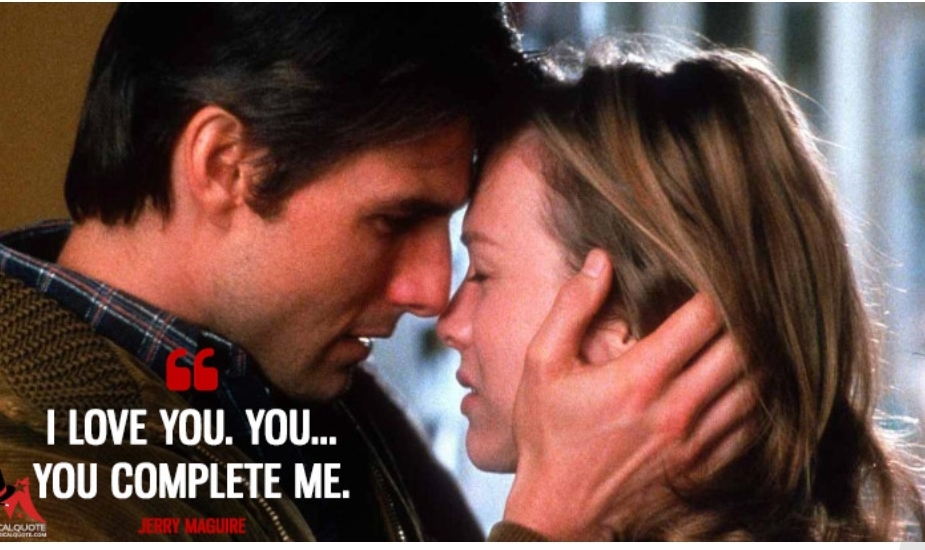
Was Jerry Maguire right?

Until we connect with ourselves, can anyone or anything make us whole? And complete us?

What’s missing in our lives is not that special someone else. What’s missing in our lives is us. Our own love and presence.

We’d do anything for those closest to us. We’d sacrifice ourselves. We’d never let them down.

Do we do the same for ourselves? Do we accept our ourselves, with all our “imperfections”, give ourselves the benefit of the doubt, and give ourselves the patience and grace that we would with those we hold dear?

I have a feeling that no one and nothing can truly complete us until we give ourselves the same love, acceptance, understanding, and patience that we’d give our most important loved ones.

Listen to your inner voice. The self doubts, fears, and criticism. And know that you’re not the voice, the doubts, fears, or criticism. Those are thoughts. You’re the awareness.

It’s time to connect with the inner voice and let them know that you’re never gonna give them up. ❤️

*With apologies to Rick Astley. 🙈

The voice who expresses those feelings needs our love and acceptance the most.

You deserve love and acceptance from yourself NOW. You don’t need to be perfect. You don’t demand your loved ones to be perfect to love them. So why demand yourself to be prefect to love yourself?

Get to know yourself. The first and most important connection. The most important of VIPs.

Direct attention to your higher self.

We are so much greater than our ego.

What hurts our ego can never harm our soul. Our higher self.

How my feelings can hurt so easily! All the while my soul remained calm, strong, unshaken.

Life would be so much more enjoyable if I lived more from the calmness of myself than the fragility of my ego.

So, I’ll focuse my attention more on my true self, the one with kindness, generosity, love, and compassion.

More so than the part who’s afraid. Afraid of rejection and abandonment. Hurts others to ask for love, to protect myself.

Always seeking love when it’s all within me the whole time.

In fact, love is me. And I am love.

And so are YOU.

Focus your attention on your higher self.

Be the creator of your life (YOU)

“Identify with the actor, not the character.”

– Srikumar Rao

If life is a movie, would you rather be a character in it, or the actor?

Character

A character’s story is written. A character may be acted upon by forces outside his or her control. The character’s story ends when the movie ends, or if the character dies. The character cannot change his or her fate.

The character is in a way completely passive, set in stone by how the actor plays it. Many characters in movies, other than the heroines and heroes, are at the mercy of their circumstances. They might even seem powerless victims.

If you had to be the character, then how about being the hero or heroine of your life? If your life is Forrest Gump, would you want to be Forrest, Jenny, Momma, or Lieutenant Dan?

But some don’t see themselves as the hero or heroine of their lives. They might not see themselves as Maverick in Top Gun, or Hermione in Harry Potter. Some might identify with an extra, out of the limelight, or maybe a victim. Bullied or ignored by other characters.

It’s your life. It’s mine. If we had to be a character, at least choose the character we become. Be the Hermione or Forrest of our life. Fulfill our potential.

Actor

The actor has more freedom. The actor can interpret and effectively create the character. The actor lives on when the movie ends, the actor survives even if the character dies. If the actor plays the character well, she may win an Oscar and go on to better roles.

We can be the actor instead of the character in our lives.

If we “play” our role well in this lifetime, our prizes may include peace and joy within, plus true happiness for ourselves and others. (see The First Step). And when the time comes for us to depart this life, we leave without regret, with nothing weighing on our heart, with nothing but love and gratitude.

And if you believe that our true self is more than this physical body, is spiritual and eternal, then you know that you will return for future roles to continue learning and growing your soul.

And even if you didn’t do so well this round, it’s okay because you can return and eventually become a superstar. Even Keanu Reeves of Bill and Ted’s Excellent Adventure became the legendary actor in The Matrix, Speed, Constantine, Point Break, among others.

Indeed.

Creator

The actor still follows the script and the director, right? The actor interprets the character but changes neither his fate nor the storyline.

How would you like to be the writer, director, and actor of your life? For example, Bradley Cooper, who cowrote, coproduced, directed, sang, and played Jackson Maine in A Star is Born. Too heavy a story? How about Greta Gerwig in Lady Bird, Tom Hanks in That Thing You Do, or Ben Stiller in Zoolander?

They wrote, directed, and acted in their own films. They created their own stories, brought their vision to life, and interpreted the characters they dreamed up.

What life would you create? How would the story go, starting today? How would you want to feel when this story ends? How would you play THE lead character of your story?

Need some inspiration to start? The Hero’s Journey may be a good template:

“A hero ventures forth from the world of common day into a region of supernatural wonder: fabulous forces are there encountered and a decisive victory is won: the hero comes back from this mysterious adventure with the power to bestow boons on his fellow man.”

– Joseph Campbell
The Hero with a Thousand Faces (1949)

YOU and I can be the hero of our life’s journey. We don’t need to limit ourselves to any character. We can create the life that we want.

* Special thanks to Kelly S. Walden, friend and counselor, for introducing me to The Hero’s Journey.

More information about The Hero’s Journey:

We live in The Matrix, Part I

The Matrix tells the story of humanity tricked into thinking that they live in a vast computer-generated virtual reality that is created by satient machines. The virtual world is set in late 20th century. The main character, a hacker named Neo, took the Red Pill in order to see the world as it truly is.

The Matrix is a modern day cave allegory of Plato. We see the world, and ourselves, based on information that comes through our senses, not necessarily reality. The prisoners in Plato’s allegory thought the world contained only the shadows projected onto the wall that faced them because they’re chained and the shadows were the only things they ever saw.

In a sense we also live in The Matrix, although not necessarily in the same way as presented in the film. Instead of a virtual reality made from ones and zeros, our Matrix is constructed, at least in a major way, from the bundles of beliefs and ideas that govern how we move through, perceive, and experience life, both internally and externally.

Many assumptions disguise themselves as beliefs and are experienced as personal knowledge. These disguised assumptions often take the form of “should” statements. For example, many of us believe that in order to be a valuable person, we should get a good job, which means we should get a good degree from a good school. We also believe that we should have a romantic relationship, marriage, mortgage, kids, etc. at various milestones. All these beliefs determine what we do, don’t do, say, and don’t say, and pretty much create the lives that each person experiences.

Most of these beliefs lie deep in our subconscious that we may not even recognize their presence. Yet they run our lives and pretty much determine how happy or unhappy we are. These beliefs determine our perceived reality, just like the simulated reality world in The Matrix.

Our beliefs comprise our reality, our life, and our world.

Our work of life is to become aware of those beliefs, evaluate them, and release (let go of) or reprogram them if they are illusory. When we release or reprogram our false beliefs, we see the world as it truly is, not seen through a distorted lense. That’s like taking the Red Pill in The Matrix.

Except that in our case, taking the Red Pill wakes us up, sets us free, and gives us bliss. Whereas taking the Red Pill in the movie put Neo in a post-apocalyptic world.

For example, I used to believe strongly, or rather I used to KNOW that I needed to be all those things to be valued as a person, for example having a college degree, getting a highly respectable job, and climbing the corporate ladder.

Although I’m very blessed and happy to have my degree, my work, and professional achievements, I now see that the connection between my value or sufficiency as a human being and all the things I thought I needed to obtain or achieve is just my belief and the society’s. But the belief or assumption about that connection has completely shaped my life and how I value myself.

I now wish to release the connection between my personal worth and material or professional achievements. The new belief I want to instill is that I am good enough and I deserve love, simply because I exist. Relying on external circumstances to demonstrate my worth, as a very wise person pointed out, would subject me to their whims and fluctuations, which can be unreliable and unstable.

And so are you. You are valued, and you are enough, simply because you exist.

This new belief might evolve into that I’m happy and content just because I exist, and it doesn’t even matter whether I’m “valuable”, “good”, or “enough.” I don’t mean to suggest that I’m quitting my job to wander the world. Although I love my job and I am grateful for my life situations, I don’t need to define my self worth with them.

What are the beliefs that may be running your life? Can you imagine how your life would differ if you released the connection between your self worth and these bundles of beliefs?